One day, feeling that he wasn't receiving the respect he deserved at home — and feeling isolated from the fraternity of higher learning that he considered his natural natural environment (even more so than a desert) — Adamillo went for a walk to the University. Of course, since he is tiny, this took him almost twenty-four hours. But at last he arrived at the University Library and checked out a book of Ezra Pound's essays. He read it showily on the immaculate lawns of the College.
He was gratified by the attention of two real-life University Students, who seemed to Adamillo both stylish and wise. He hoped more than anything that they would walk up to him, engage him in a discussion about Pound, and offer him some of their peanuts. But of course their only interest was in the spectacle of a tiny stuffed armadillo pretending to read a book that was in fact placed upside down.
Depressed by his failure to make either friends or sense of the essays, he decided to drown his sorrows in iced coffee and deep fry them in batter. His first stop was Tim Horton's.
For only a few dollars, he purchased a delicious drink that was, in volume, six times his size. He drank as much of it as he could and found it delicious. Then he crossed the street to Chippy's.
He asked for their Armadillo-Sized Lunch Special, but the fellow behind the counter with the artfully arranged black hair and nose ring informed Adamillo that there was no such special. So he ordered what was available, the Lunch Special, and asked for an Armadillo-Sized Cup to eat it from. This they provided.
Already full from his Iced Cappuccino, he was worried that he wouldn't be able to finish even this small fragment of the larger meal. In fact he was not.
Ill in body and spirit, he made his way very slowly home from Chippy's (it took nearly two days). When he arrived he found that he was feeling much better. He comforted himself by chewing on sticks (his favourite activity) and also on the straw wrapper from his Iced Cappuccino, which he had saved.
Tuesday, March 23, 2010
Thursday, March 11, 2010
Fish Six-Pack
To appease readers disappointed with my post on The Bachelor, I offer the following work of original art. It is the first in a triptych depicting animals in difficult situations. Here, in my most political work to date, I show six fish caught in a plastic six-pack beer ring, which has been carelessly tossed unsnipped into the tropical sea.
Monday, March 8, 2010
A Reading List for The Bachelor
Poor, stupid Jake Pavelka.He certainly was in a brilliant position to begin with. A massive and enthusiastic harem; a moral carte-blanche from the American viewing public for the duration of the season; and the counterbalancing, conventionally reassuring knowledge that at the end of the lengthy tunnel of license (or, as repeatedly called it, his “awesome journey”) a loving wife would be waiting for him.
But then, after months of painstaking culls, what a terrible circumstance! After much sham-polygamy and faux-polyamory, he was confronted with a truly impossible decision. With Tenley and Vienna he had an almost perfect manifestation of the well-known “angel/whore dichotomy.” And, dichotomies being what they are, Jake—his carte-blanche suddenly turned a forbidding, unsexy, either/or shade of red—could not have both.
Why did he find himself in this tricky situation? Was it that the producers wanted an exciting finale, and told him to choose the most diametrically opposed contenders imaginable? Was it because, having spent the duration of the show doing whatever he wanted, he began to believe he could have his whore and angel too?
No. Jake Pavelka found himself in this difficult predicament because he had not read enough books, and as a result possessed a naïve understanding of human behaviour.
In a heart-rending and blubbery monologue, he told Tenley (I find I like her better when I call her “Tinsley”), “You’re incredible. You’re perfect. You’re so good. I’ve never met anyone like you. But I put you on a pedestal, and when I’m with you it all feels a bit forced.” Things didn’t feel natural with the angel. But with the whore Jake felt he could be himself. As a result he decided to marry her.
If only you had read Proust, you benighted pilot! From him you would have learned that there are no angels and no whores in this world—that there is no “self” at all, in fact, but rather a complex agglomeration of selves: numerous angels and whores of various degrees within each of us, which roles we perform as the occasion suits—what Proust calls “les moi en moi.” (You might have learned this for any number of other novels as well. Anna Karenina springs to mind as an example of a novel in which a too-constricted sense of the range of personal identities leads to catastrophic consequences.)
You ought also to have read Milton’s Paradise Lost. Satan, who would surely appeal to you on many other grounds—for you were, temporarily, “beyond good and evil”—has the following sagacious advice for you. In the very first book of Milton’s epic, Satan says to his followers,
The mind is its own place, and in itselfThe pedestal on which you tragically placed Tenley, in other words, was your own creation. To quote Milton’s disciple Blake, the “manacle” in which you found yourself caught was in fact “mind forg’d.” Tenley was no simple angel, as anyone not distractedly slobbering over the revolting Vienna would no doubt have noticed. She was even much prettier than the other—which is why she was so confused when you told her you found her physically unattractive. But you, Jake Pavelka—you poorly-read simpleton and cliché-loving oaf—misread the situation as a stereotypical dichotomy of the crudest sort. And picked the wrong side of it to boot!
Can make a Heaven of Hell, a Hell of Heaven.
And people say that literature is useless!
Friday, February 26, 2010
Faulkner's Corn Cob: How I Know Nabokov Would Have Liked Wyndham Lewis
Since I like Wyndham Lewis so much, and since so few other people do, I am often curious to know how my favourite artists feel about him.
As far as I know, neither read the other. I have never seen a review or mention of the one by the other. But I do have the following excellent reason for supposing that, critically speaking, they would have gotten along. They both make delightful fun of William Faulkner, in precisely the same way.
I don't like Faulkner. I find his prose unbearable. It is one of the great mysteries of my life why a relative would have given a Faulkner "box set" containing The Sound and the Fury, As I Lay Dying and others to my mother for Christmas one year. So I was reassured when I first read Lewis's Men Without Art (1934) and saw that he also disliked Faulkner. In a chapter titled "The Moralist With the Corn-Cob" Lewis produces impressive lists of stupid words over-used by Faulkner, such as "myriad" and "sourceless." He also produces purple passages like this:
I must confess that I had no idea what all this corn cob business was about. I found it to be a funny phrase, and I supposed it was some sort of good joke. Luckily I kept the image in my head. Because it was the key to settling the question, "Would Nabokov and Lewis get along?"
One day I was told to look up the Nabokov videos on YouTube. Let me tell you, they are very good. The one of Nabokov on our very own CBC is disorienting and dizzying in more senses that one. But the video called "Nabokov and the Moment of Truth" was the one that provided the revelation. I have embedded it below. Advance it to the 3:25 mark and pay special attention at 3:50.
In this passage Nabokov says the following (reading from a script, as apparently he always did in interview):
But in any case: that Nabokov and Lewis, my two favourite prose stylists of the English language, should demean Faulkner—one of my least favourite English prose stylists—in the exact same manner I consider sufficient proof that they would get along, and that my taste is coherent. Perhaps at some small table in a particularly unfashionable corner of heaven (for they are both there!), the two of them meet once a decade for a chat.
I leave you with a painting of my dog, drawing a strong visual simile between corn cobs and his Golden Retriever snout.
Since Lewis was so famously jerky, answers are surprisingly easy to come across—surprising given the fog of neglect in which WL otherwise sits. Hemingway, for instance, definitely did not like Lewis. He famously said, in A Moveable Feast, that Lewis possessed "the eyes... of an unsuccessful rapist." (Speaking of A Moveable Feast, I was once on a bus ride when the person sitting next to me struck up a conversation and said "Oh, A Moveable Feast—reading that book makes me so hungry!") Virginia Woolf was terrified of Lewis. The mere announcement of a forthcoming review from Lewis's pen led her to write in her diary, "Now I know by reason and instinct, that this is an attack; that I am publicly demolished; nothing is left of me in Cambridge and Oxford and places where the young read Wyndham Lewis."
This is the sort of behaviour I would expect from Hemingway and Woolf—it would be weird and make me uncomfortable if they were to say something nice about Lewis. (Lewis did write a chapter on Hemingway called "The Dumb Ox," after all.) It makes me very happy, however, when people I really like turn out to like Lewis. For example, Mark E. Smith of the English punk band The Fall. Here are his remarks on Lewis, from a 1986 issue of Melody Maker, where he lists his heroes (among them Hulk Hogan and Philip K. Dick):
He was a funny old stick, Wyndham Lewis, the most underrated writer this century. I can't believe how good his stuff is when I'm reading it. He was a much better writer than he was a painter. People always say that Paul Morley ripped off Lewis, which is bollocks. WE ripped off Lewis, and Morley stole his ideas from us! The thing that pissed me off is that ZTT uses his ideas and then put them into a context that Lewis would have hated. He loathed the futurists. His stories are great; things like 'The Crowd Master' in Blast. What a great title for a story. Wyndham Lewis is so real and so now. He wrote a book about Hitler in 1934 [actually 1931] saying that this is maybe the way forward and was condemned during and after the war for being a Nazi. Yet in another book, 'Rotting Hill', he says he wrote an essay in 1938 to say that he was completely wrong and that Hitler had to be stopped [The Hitler Cult, published 1939]. The critics made sure he was only remembered one way - the wrong way. He was a real man though. He'd always be the first to condemn himself if he got something wrong. He went for the critics before they went ever got to him. I like people than can admit to their mistakes. When people ask me about The Fall back in '77 and the whole punk thing I say it was shit. Everyone hated us. Punk bands hated us. Even we hated us! I'm not going to lie about it. It's hard, but I like people that are real and tell the truth. His books are hard to read but if you stick with them they're great. "Rude Assignment' - what a title! 'Rotting Hill' is the greatest phrase I've heard in my life. It's so simple you'd never think of it. The things he was talking about in 1911, people are just beginning to talk about now. A man years ahead of his time.Anyway, I'm getting off-topic. The question I have set out to answer is: Would Vladimir Nabokov have liked Lewis? As people, I'm sure they wouldn't have gotten along. And perhaps Nabokov would have been a bit too much an aesthete to please Lewis, and Lewis too much of a politician to please Nabokov. But they do have a lot in common, especially as critics. They are uncompromising and belligerent, and they're lively and entertaining.
As far as I know, neither read the other. I have never seen a review or mention of the one by the other. But I do have the following excellent reason for supposing that, critically speaking, they would have gotten along. They both make delightful fun of William Faulkner, in precisely the same way.
I don't like Faulkner. I find his prose unbearable. It is one of the great mysteries of my life why a relative would have given a Faulkner "box set" containing The Sound and the Fury, As I Lay Dying and others to my mother for Christmas one year. So I was reassured when I first read Lewis's Men Without Art (1934) and saw that he also disliked Faulkner. In a chapter titled "The Moralist With the Corn-Cob" Lewis produces impressive lists of stupid words over-used by Faulkner, such as "myriad" and "sourceless." He also produces purple passages like this:
Moonglight seeped into the room impalpably, refracted and sourceless; the night was without any sound. Beyond the window a cornice rose in a succession of shallow steps against the opaline and dimensionless sky.For me this is damning evidence. Lewis concludes, "William Faulkner is not an artist: he is a satirist with the shears of Atropos more or less: and he is a very considerable moralist—a moralist with a corn-cob!"
I must confess that I had no idea what all this corn cob business was about. I found it to be a funny phrase, and I supposed it was some sort of good joke. Luckily I kept the image in my head. Because it was the key to settling the question, "Would Nabokov and Lewis get along?"
One day I was told to look up the Nabokov videos on YouTube. Let me tell you, they are very good. The one of Nabokov on our very own CBC is disorienting and dizzying in more senses that one. But the video called "Nabokov and the Moment of Truth" was the one that provided the revelation. I have embedded it below. Advance it to the 3:25 mark and pay special attention at 3:50.
In this passage Nabokov says the following (reading from a script, as apparently he always did in interview):
I've been perplexed and amused by fabricated notions about so-called Great Books. For instance, Mann's asinine Death in Venice; and Pasternak's melodramatic and vilely written Doctor Zhivago; or Faulkner's corn-cobby chronicles.Corn-cobby chronicles! I almost fell out of my seat when I first heard Nabokov utter those divine words. At first I thought it was evidence that Nabokov had in fact read Lewis—that he was making fun of Faulkner via Lewis's essay, "The Moralist with the Corn-Cob." A bit of further research revealed that in fact in Faulkner's novel Sanctuary one character rapes another with a corn cob. I'm happy I've never read that book.
But in any case: that Nabokov and Lewis, my two favourite prose stylists of the English language, should demean Faulkner—one of my least favourite English prose stylists—in the exact same manner I consider sufficient proof that they would get along, and that my taste is coherent. Perhaps at some small table in a particularly unfashionable corner of heaven (for they are both there!), the two of them meet once a decade for a chat.
I leave you with a painting of my dog, drawing a strong visual simile between corn cobs and his Golden Retriever snout.
Friday, February 19, 2010
R.I.P. Kitz
Today I saw a Kitty who got the worst of an encounter with a train.To prevent this ever happening again, I have created a super-hero named Panini Loaf. Panini Loaf's job is to warn all cats to stay away from train tracks, and to "train" Mama Cats how to teach this lesson to their Kittens and Teens.
May that Kitty rest in peace.
And you, Panini Loaf: Allez!
Tuesday, February 16, 2010
A Schoolyard Conversation Between Three Cats
Speaking of James Joyce, the following is inspired by A Portrait of the Artist as a Young Man. It is a schoolyard conversation between three cats.
So Kitsie, we hear your Mama Cat kisses
you at night when you go to sleep.

Yeah we heard she
kisses you every night.
Hmm, then I guess your
Mama Cat doesn't love you!
Okay, okay.
I bet she cleans
his anus too!
Well, I guess that
explains why you're
so stinky.
You're not going to trick
me this time, guys.
AHAHAHAHA!
[Gulp]
So Kitsie, we hear your Mama Cat kisses
you at night when you go to sleep.

Ummmm.
Yeah we heard she
kisses you every night.
Umm... no!
No, guys, my Mama
Cat doesn't kiss me!
Hmm, then I guess your
Mama Cat doesn't love you!
Because everyone knows
that a Mama Cat
that a Mama Cat
who loves her Kitten kisses
him at night before bed.
Isn't that right?
Yeah, that's right.
Everyone knows it.
Okay, okay.
Then she does kiss
me at night!
me at night!
My Mama Cat kisses me.
AHAHAHAHAHA!
Did you hear that?
KITSIE'S MAMA
CAT KISSES HIM!
CAT KISSES HIM!
[Gulp]
AHAHAHAH!
I heard it alright!
I bet she cleans
his anus too!
No way, guys!
Hey, that's gross!
She doesn't clean
my anus!
my anus!
Well, I guess that
explains why you're
so stinky.
You know, it's a Mama
Cat's responsibility
to clean her Kitten's anus.
Otherwise he'll get
made fun of for being
stinky.
made fun of for being
stinky.
Yeah, your Mama Cat does a
bad job of keeping you clean.
Just look at the marmalade
jam on your chin.
jam on your chin.
You're dirty and you smell bad.
You're not going to trick
me this time, guys.
I don't let my Mama Cat
clean my anus,
clean my anus,
but I'm not stinky.
I lick my own anus.
Did you hear that?
KITSIE LICKS HIS
OWN ANUS!
OWN ANUS!
AHAHAHAHA!
I heard it alright!
[Gulp]
Thursday, February 11, 2010
History of the English Language
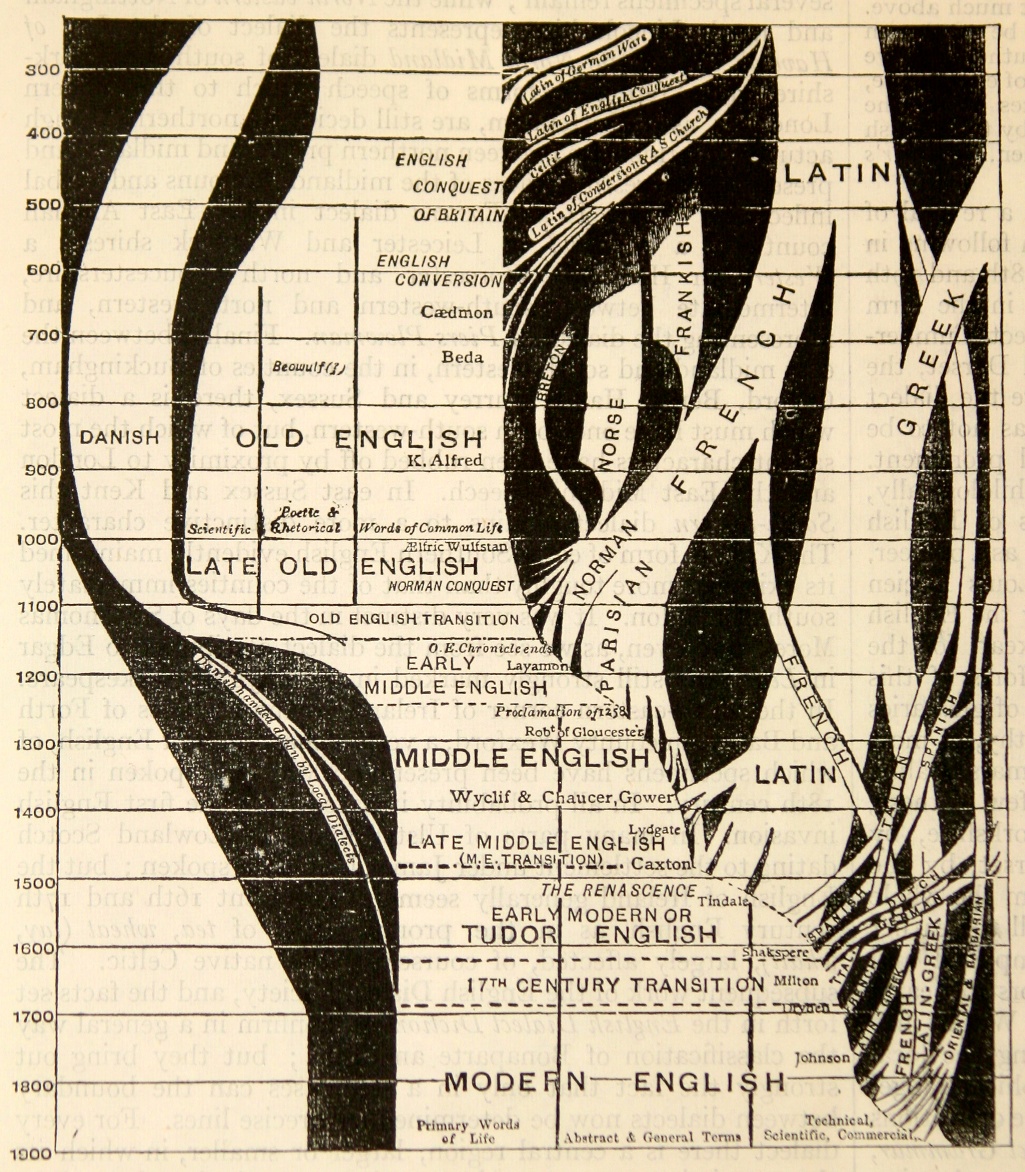
In Virginia Woolf's Letter to a Young Poet she says, "English is a mixed language, a rich language." Here, in graphic form, is the proof.
When I was an undergraduate I wrote an essay on the "Oxen of the Sun" chapter of James Joyce's Ulysses, and the general idea of "history." In the course of researching that paper, I came across an image representing the history of the English language as a sort of nightmarishly complicated confluence of rivers. But I didn't note where I had found it, nor did I "use" it in the resulting essay. Since I became increasingly obsessed with this image over the years, I eventually went on a hunt for it. Five or six years after I first spotted it, I was reunited with the image this past winter, and can now introduce it to you. (Before I do so, click on it to enlarge—you'll be able to spot most of the details.)
English really is a strange language. It's a highly appropriate language to have taken over as the new "lingua franca," because it comes from all over. I knew about the collision between the Germanic Old English and Latin French before seeing this image; but there are, as we see, many others. I wasn't aware that Danish had such an influence, for example. Nor had I considered the "sneaky late arrival" of Greek into the technical language of the sixteenth century. This general division of labour between invading streams is interesting too—according to this chart, basically all of the words of daily life come directly from Old English, and basically nothing else does. It's hard to change our daily habits, English speakers, but we're marvelously open to new ideas!
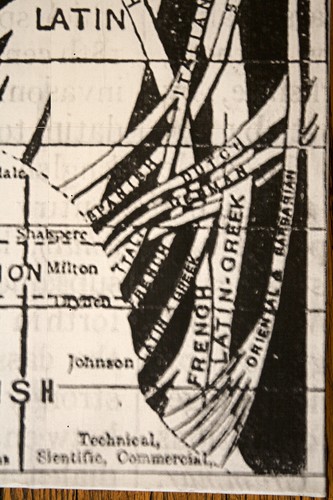
Of course the diagram itself is interesting. On the one hand, it wants to show us how complicated and messy the history of the English language has been. On the other hand, it wants to make sense of this for us. As the course of the River English approaches the present day (this was produced around 1910), things become too complicated to represent—though the encyclopedic urge persists, and the diagrammer does absolutely everything in his power (it is surely a he!) to detail the smallest intricacies of the discontinuous influence of, say, "Oriental and Barbarian" (without specifying which!) tongues. And the lines do, in fact, resemble tongues—though more closely and increasingly the forked ones of serpents!
I'm sure that such a map would be completely impossible to produce today. The English language, in spreading and coming into contact with endless other languages, is always changing. And there is no longer—if ever there was—an English language, of course, but many. "Rich and mixed"—Virginia Woolf is right!
I am just as attracted to this image as an image. It has a lurid, organic, veiny quality. There's something thrilling and dangerous about all those tentacles! I therefore asked my friend Mardam Hammowicz to make one of his gigantic enlargements of this image for me. You can see the process on her Flickr page. This way of enlarging the image, with all its patched-together-ness, just reinforces the "message" of the image itself: that the language we speak and write in is a tremendous jumble.
It's a fine image to keep in front of one's face—and a fine lesson to keep in one's mind—as one writes!
Subscribe to:
Posts (Atom)